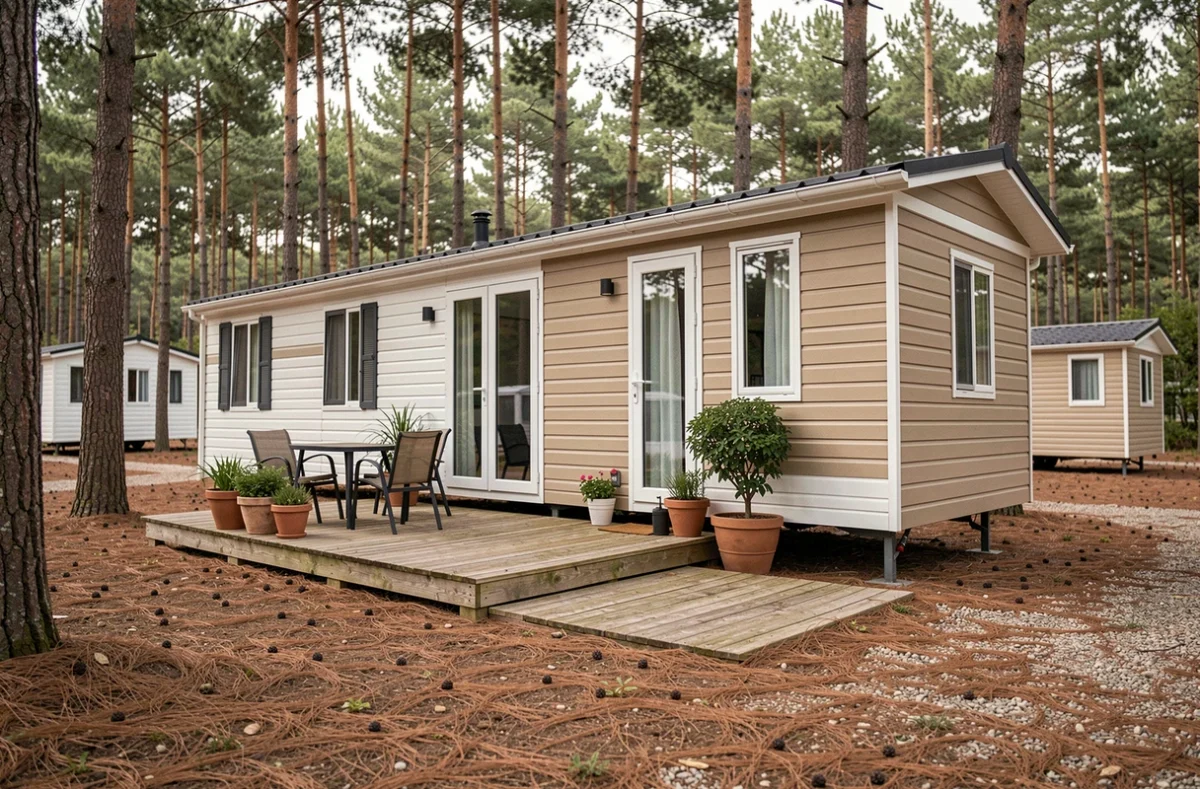
A new mobile home delivered to a camping plot is often an impulsive purchase triggered by a successful weekend. You sign, you place the mobile home, and it’s six months later, upon receiving the plot rent invoice or a replacement clause, that the questions arise. Investing in a plot with a mobile home means securing the placement contract even before choosing the model.
Camping Plot Contract: The Document That Conditions the Entire Investment
The mobile home is a movable property. Its value directly depends on the conditions of occupancy of the plot on which it is installed. Without a solid contract, you find yourself owning a dwelling that you cannot rent freely, resell easily, or even keep beyond a certain duration.
As Trend Immo’s advice reminds us, the recommended decision-making order is plot first, mobile home second. Buying a model before obtaining written approval from the camping site can lead to a property that cannot be installed.
The points to check in the plot contract are not secondary; they determine the actual profitability of the operation:
- The duration of the contract and renewal conditions: an annual renewable lease does not offer the same security as a multi-year commitment. Check the notice period for non-renewal and the grounds for termination.
- The indexation of the plot rent: some campgrounds apply annual increases without a contractual ceiling, which erodes profitability over the seasons.
- The subletting rules: many campgrounds require you to go through their own rental management service, with a commission that can significantly reduce income.
- The exit obligations: the contract may stipulate the removal of the mobile home at your expense in case of non-renewal, a cost that can represent several thousand euros.
A ministerial response recommends using a contract template developed by the FNHPA and the FFCC to limit abusive clauses. This is not always offered spontaneously by operators.

Camping Plot or PRL Site: Two Different Risk Profiles
People often confuse traditional camping with residential leisure parks (PRL). Both allow for the installation of a mobile home, but the legal framework and level of stability are not comparable.
In camping, the plot is rented. The landowner remains the operator, and the rental contract for the plot is the only legal link between you and your right of occupancy. If the camping site changes ownership or business strategy, your situation can change rapidly.
The PRL can offer a more stable environment. Some parks offer long-term leases, even the transfer of usage rights on the plot. This does not mean that the land is purchased with the mobile home, but the contractual framework tends to be more protective for the owner of the movable property.
What Changes in Daily Life
In camping, the operator sets the internal regulations, sometimes imposes a specific model of mobile home, and may require the replacement of the property after a certain number of years. In PRL, aesthetic and technical constraints also exist, but the relationship is often more balanced.
Feedback on this point varies according to the establishments. Before signing, it is beneficial to ask other owners already installed in the targeted park.
Age of the Mobile Home and Replacement Clause: The Most Costly Trap
Many campgrounds mention a replacement threshold in their internal regulations, often set around fifteen or twenty years. This requirement pushes owners to buy a new mobile home to keep their plot.
No legal maximum age automatically requires the replacement of a mobile home. The thresholds set by operators fall under the plot contract or internal regulations, not a regulatory obligation. The NF S 56-410 standard concerns electrical installations, gas, and safety, regardless of the property’s age.
In practice, a campground may refuse to renew the contract if the mobile home no longer meets its aesthetic or technical criteria. The owner then faces a choice: invest in a new model or leave the plot, bearing the costs of transport and dismantling.
How to Limit Exposure to This Risk
Before purchasing, request in writing the replacement criteria applied by the campground. A transparent establishment will provide a document specifying the exact conditions (age, condition, technical compliance). Prefer campgrounds where the contractual duration exceeds the estimated depreciation period of the mobile home.
LMNP Taxation and VAT: What Buying a Mobile Home Really Allows
The status of non-professional furnished rental (LMNP) applies to the rental of a mobile home installed in a camping or PRL. This regime allows for the deduction of expenses (plot rent, maintenance, insurance) and the depreciation of the property for accounting purposes, which reduces or even eliminates taxation on rental income for several years.
The simplified real regime is often more advantageous than the micro-BIC for a mobile home, as the plot charges and depreciation absorb a large part of the income. A specialized accountant in LMNP can precisely quantify the tax benefit according to your situation.
Recovering VAT on the purchase of the mobile home is possible under certain conditions: the property must be operated in a classified tourist residence offering at least three para-hotel services. Not all campgrounds meet this criterion. Check the classification of the establishment and the services offered before relying on this lever.
Reselling a Mobile Home on a Plot: A Market Without Official Pricing
A mobile home loses value each year. Unlike real estate, there is no standard price reference like the DVF base. The depreciation is rapid, and the second-hand market largely depends on the location and the campground’s policy.
Some operators prohibit resale to an outside party or require you to go through their own sales network, with a commission. Others allow free sales but retain a right of approval over the buyer. These clauses are included in the plot contract, highlighting the importance of reading it thoroughly before the initial purchase.
Investing in a plot with a mobile home is not a traditional real estate investment. It is a purchase for comfort and seasonal rental income whose viability relies on three elements: a secured placement contract, well-calibrated LMNP taxation, and a clear anticipation of the duration of operation before resale or replacement.