
It’s Sunday evening, the remote in one hand and the phone in the other. We’re scrolling through the channel guide, opening a streaming app, closing it, and returning to live TV. Ten minutes later, we still haven’t started anything. The problem isn’t the lack of content, it’s the excess of choices facing a poorly defined need.
Start with the mode of distribution before the type of TV program
The first mistake is looking for a movie or series without knowing where we’re going to watch it. The classic reflex is to flip through the live TV channels, but linear television no longer meets all needs. Between live broadcasts, catch-up, on-demand catalogs, and free FAST channels, each mode of distribution has its own strengths.
Specifically, if we want a program for tonight without waiting, live or catch-up remains the quickest options. We check the guide, spot the time slot for the evening on France 2 or Canal, and that’s settled. However, when we’re looking for a specific series or a movie we’ve heard about, paid platforms become the first reflex for nearly half of French viewers, according to Arcom data.
The mode of consumption also depends on age. Traditional television remains very popular among those over 50, while 15-34 year-olds tend to turn more towards YouTube, social media, or subscription services. Before filtering by genre, we save time by asking a simple question: do I want live, catch-up, or a catalog?
To quickly cross-reference these different sources and find the TV program on Slouppi, we access a guide that aggregates both linear grids and thematic suggestions, which avoids juggling between multiple apps.
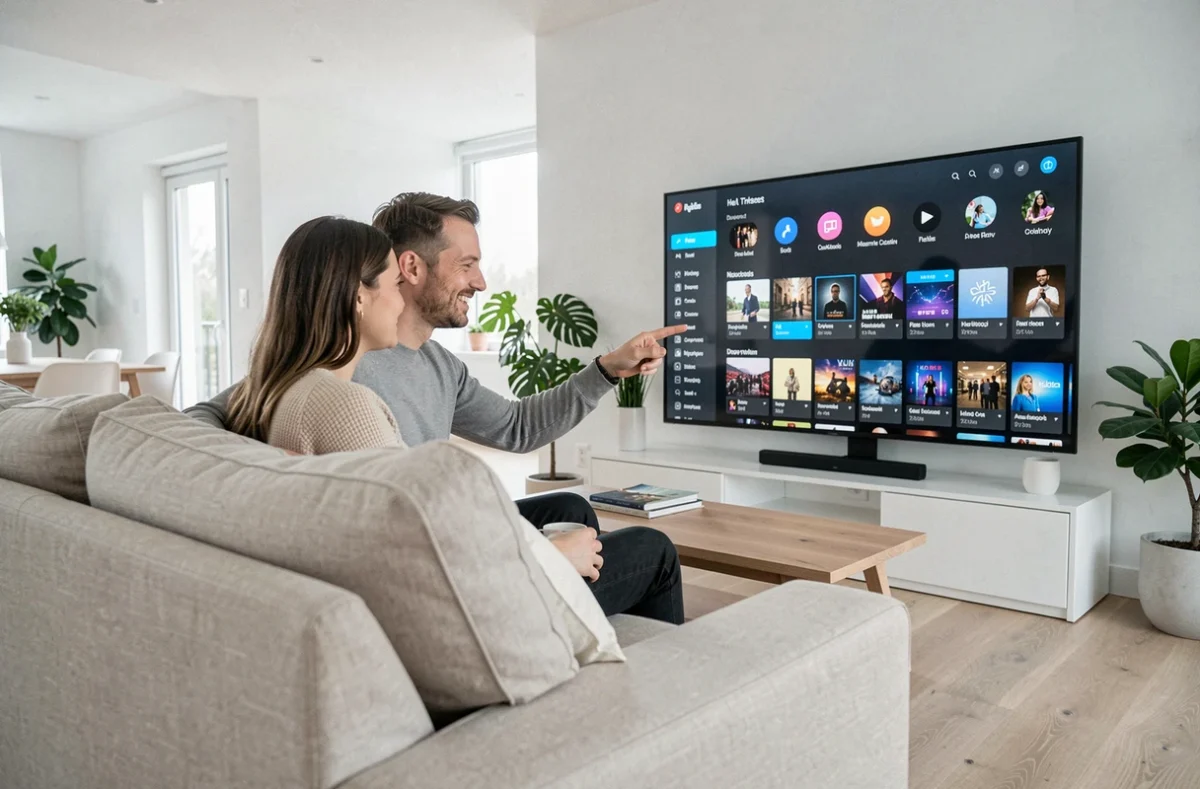
Filter by current mood rather than by TV channel
Browsing through channels one by one is like entering a supermarket without a shopping list. We end up picking whatever is on the end cap. The most effective shortcut is to identify our mood before touching the remote.
We can narrow down the choices to four main categories that cover most evenings:
- Light entertainment (talk shows, games, reality TV) when we want to unwind effortlessly after a busy day.
- Fiction (movies, series, new TV films) when we crave a narrative that keeps us on the edge of our seats for one or two hours.
- Information and culture (magazines, documentaries, debates) when we seek to understand a current topic or discover a specific theme.
- Live sports, which impose their own schedules and leave no doubt about the program to choose.
Once the category is established, sorting takes just a few seconds. On an online TV guide, we filter by genre, time slot, and channel. Three clicks replace twenty minutes of zapping.
The trap of overly enticing summaries
Program descriptions in electronic grids are written to entice. A movie summary always promises “a thrilling plot” or “a poignant drama.” Rather than relying solely on the summary, it’s beneficial to check the name of the director or showrunner and cross-reference with a quick review on a third-party site. This habit helps avoid recurring disappointments on Tuesday nights.
Catch-up and replay: recover a missed TV program without stress
We missed the documentary on France 5 that aired at 9 PM because we were having dinner at friends’ houses. In the past, that would have been lost. Today, catch-up transforms the program grid into a permanent catalog available several days after airing.
Most TNT channels offer their shows for catch-up via their apps or on the internet box. France TV, TF1+, M6+, and Arte.tv alone cover a large part of the free programming. A useful reflex is to mentally note a program spotted in the evening guide, even if we know we won’t be in front of the television at the airing time.
Opinions vary on this point, but several viewers find that watching on catch-up provides extra comfort: no ads on certain platforms, the ability to pause, and choosing the moment. The evening program is no longer a time constraint; it’s an option we activate whenever we want.

Accessibility and subtitling: a choice criterion often overlooked
We don’t always think about it, but the choice of a program also depends on its technical availability. Subtitles for the hearing impaired, audio description for the visually impaired, sign language on certain slots: these options concretely guide the selection for millions of viewers.
The European Accessibility Act, transposed in France by an ordinance in September 2023, gradually requires digital audiovisual services to make their content accessible. In practice, this means that platforms and channels must clearly display accessibility options in their program guides.
When choosing a program for a family evening where a relative needs subtitles, checking for the dedicated icon in the TV grid becomes the first filter. Some online guides allow sorting directly by subtitle availability, which saves considerable time.
Online TV grid or mobile app: which program guide to use
Sites like Télé 7 Jours, Télé Loisirs, or TV-Programme.com offer complete grids over two weeks, with filters by channel and genre. Their main advantage is broad coverage (TNT, cable, satellite) and associated articles on current series or films.
Mobile apps linked to internet boxes (Orange TV, Free, SFR) offer a different advantage: they directly display what is available on the current subscription, without showing channels we don’t have access to. Sorting is quicker because it aligns with the actual offer.
For an evening where we hesitate between live and streaming, combining a general TV guide with the app of our box remains the most straightforward method. We spot the program on the guide, check its availability on the box, and launch it. No need to compare ten sources when two are sufficient.
Ultimately, the choice of a TV program comes down to a simple habit: define the mode of distribution, identify the current mood, check technical availability. These three filters, applied in this order, reduce the decision time to just a few minutes, even in the face of hundreds of channels and catalogs.