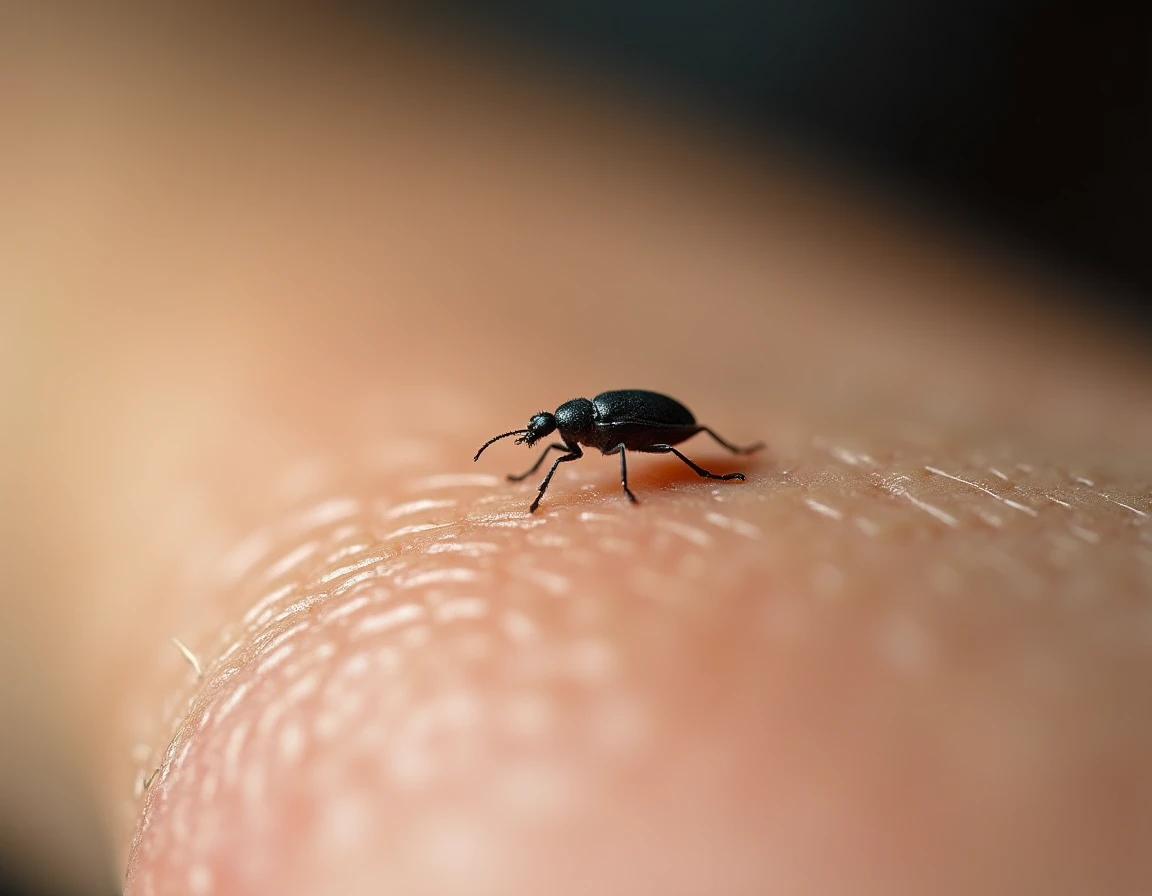
We are in the garden, feeling an itch on the forearm, and when we look down, we spot a barely visible black dot on the skin. The reflex is to crush it. This is sometimes the worst thing to do, as some of these tiny black insects release a toxic substance when crushed on the skin.
Toxin or sting: the distinction that changes everything in the skin reaction

When discovering a tiny black insect on the skin, the first reflex is to think of a sting. In the majority of cases, the lesion that appears afterward indeed comes from a biting insect (biting midge, no-see-ums, blood-feeding gnat). The female pierces the skin to draw blood, and her saliva causes redness, swelling, and itching.
There is a very different case, often misdiagnosed. Beetles of the genus Paederus, small black and orange insects just a few millimeters long, do not sting at all. When crushed on the skin, they release pederin, a caustic toxin that causes a chemical burn.
The lesion resembles a red streak, sometimes vesicular, that appears several hours after contact. European poison control centers report frequent diagnostic errors, with the lesion being treated as a classic sting when it actually requires thorough washing with water and soap, not an antihistamine.
The ground rule is simple: if the insect is on the skin but hasn’t stung yet, slide it off with a nail or paper rather than crushing it. Avoid any rubbing.
Identifying the most common tiny biting black insects in France

Among the species that pose daily problems, three groups consistently appear in field situations.
Biters and no-see-ums in wet areas
Biters (small black flies) and no-see-ums (Ceratopogonidae) are the main culprits for tiny black insect bites outdoors. Their size, often less than three millimeters, makes them almost invisible. They are found near waterways, ponds, and increasingly in urban gardens close to wet areas.
Recent entomological studies show a northward progression of these biting species in Western Europe, linked to climate change. They are now encountered in regions where they were rare just a few years ago. The bite of the no-see-um is disproportionate to its size: sharp pain, intense itching, and sometimes persistent swelling for several days.
Thrips and small beetles in the garden
Thrips, these thread-like insects measuring one to two millimeters, frequently land on the skin in summer. Their “sting” is actually an exploratory bite: they test the surface with their mouthparts but do not feed on blood. The sensation is that of a brief prick, rarely followed by lasting redness.
Distinguishing them from true biters helps avoid unnecessary treatment. A thrip on the arm does not warrant corticosteroid cream or a consultation.
Reacting to a bite from a tiny black insect: the field protocol
Management depends on what is observed in the minutes and hours that follow. Here are the concrete actions to take based on the situation:
- Localized itching with a punctate lesion: clean with water and soap, apply cold (wrapped ice) for about ten minutes. This is sufficient in the vast majority of cases.
- Red streak or blister appearing several hours later: suspect contact with a Paederus or a toxin-bearing insect. Wash thoroughly without rubbing, do not puncture the blisters, and consult if the area spreads.
- Significant swelling, local warmth, fever, or a red streak that progresses: consult quickly, as these signs may indicate a superinfection or a serious allergic reaction.
- Multiple grouped bites in the same area: typical of biting midges that attack in swarms. Itching may last several days. An oral antihistamine helps to get through it.
The French Society of Dermatology has recommended since 2023 telemedicine as a first-line option for unexplained bites. Taking a clear photo of the lesion (and the insect if preserved) allows the dermatologist to make a diagnosis remotely and avoid unnecessary antibiotic prescriptions.
Preventing bites from tiny black insects: what really works
Not all preventive measures offer the same level of protection. Their effectiveness varies depending on the type of insect and the environment.
Long, light-colored clothing remains the most reliable barrier against biting midges and no-see-ums. These insects are attracted to dark colors and exposed skin areas. A tightly woven fabric at the ankles and wrists blocks the majority of attacks, as no-see-ums target extremities and skin folds.
For skin repellents, formulations based on DEET or Icaridin are the most documented against small biting diptera. Essential oils (lemongrass, lemon eucalyptus) offer shorter protection, and feedback varies on this point depending on the species present locally.
Fine mesh mosquito nets (less than a millimeter) are the only truly effective means to sleep without being bitten in infested areas. Standard mosquito nets easily allow no-see-ums and biting midges to pass through.
- Avoid outings at dawn and dusk near wet areas, peak activity times for Ceratopogonidae.
- Eliminate standing water in the garden (saucers, clogged gutters) to reduce breeding sites.
- Ventilate terraces: small biting insects fly poorly in moderate wind, a simple outdoor fan significantly reduces their presence.
The real trap with tiny black insects is treating all situations the same way. A thrip on the arm in the middle of summer does not call for the same reaction as a swarm of biting midges by the river or a crushed Paederus on the neck. Photographing the lesion and sliding the insect off instead of crushing it remains the most useful gesture to limit complications.