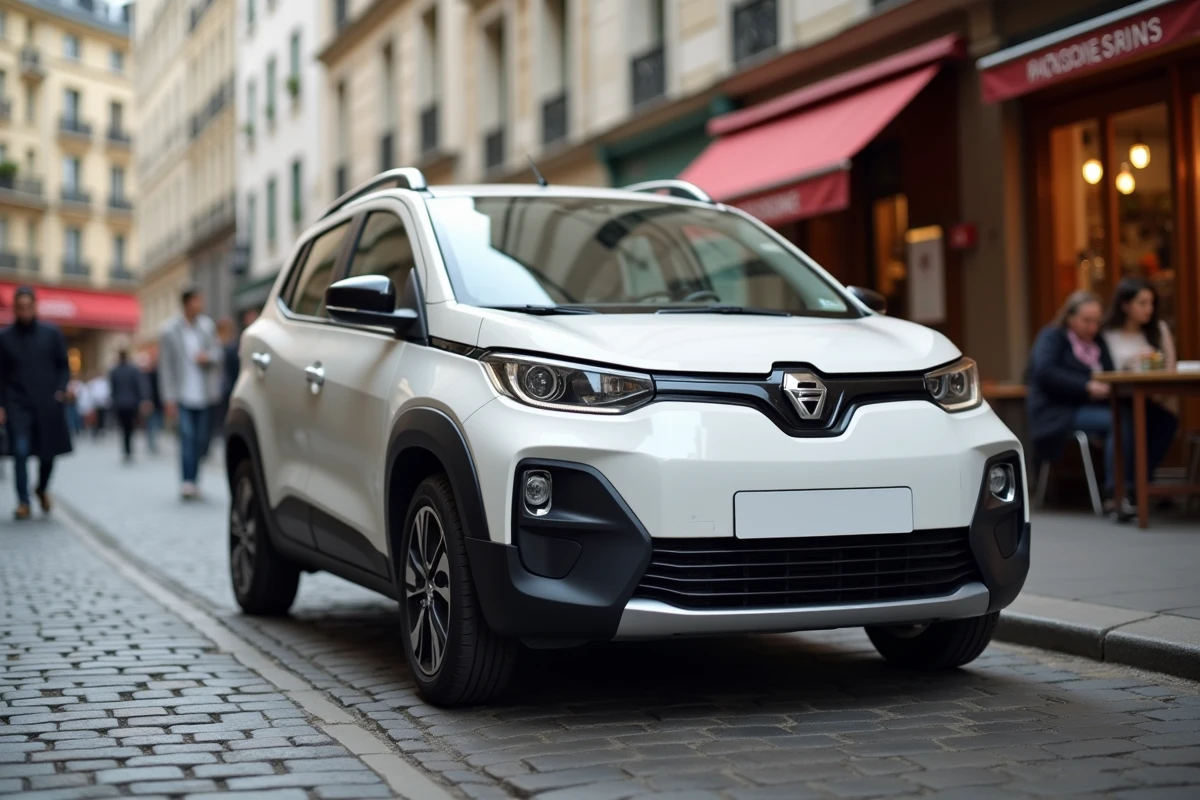
The Dacia Towny regularly comes up in conversations whenever new budget cars are discussed. However, this model has never made it to dealerships. It remains a media project, mentioned since the early 2010s in the form of rumors and photomontages. Forming a complete opinion on the Towny, therefore, involves analyzing a concept, its promises, and especially what explains its absence from the Dacia catalog.
Dacia Towny: an ultra-low-cost city car project never realized
The name “Towny” first circulated around 2012. The idea seemed simple: to offer a five-door, five-seat city car at a symbolic price. The Towny was supposed to be positioned below the Sandero in the Dacia lineup, targeting urban drivers with a very tight budget.
Several specialized media outlets published photomontages and technical projections. Automotive forums took up the topic. Discussions focused more on the credibility of the project than on potential performance or daily use, due to the lack of a running prototype accessible to the press.
At this point, one point deserves to be made clear: no production version of the Dacia Towny exists. There has been no road test, no official technical sheet validated by the manufacturer, and no commercialization. The project has remained at the level of industrial rumor.
You can find a review of the Dacia Towny on Auto World that places this model in the broader context of the Dacia range and its pricing ambitions.
Price under 5,000 euros: why this price has become unrealistic

The main argument for the Towny hinged on one figure: a very low starting price, often announced around 5,000 euros. At the time, this positioning echoed the success of the Logan, which had shown that a new car could cost significantly less than the average in the European market.
Since then, the landscape has changed. European homologation standards now impose safety equipment that did not exist or was not mandatory in the early 2010s. Among the constraints that have made this price difficult to maintain:
- Emergency automatic braking, now mandatory on new vehicles sold in Europe, adds costs for sensors and onboard software.
- Emissions requirements have tightened engine standards, increasing development costs even for a simple thermal block.
- Euro NCAP crash tests, although not mandatory, strongly influence the perception of a model. A manufacturer launching a city car without a decent score takes a major commercial risk.
Producing a new car homologated in Europe for this price is now very unlikely. The costs of raw materials, regulatory compliance, and logistics have all increased.
Dacia Spring and evolution of the range: what has replaced the Towny concept
Rather than continuing down the path of an ultra-budget thermal micro-city car, Dacia made a different choice. The brand has shifted its entry-level offering towards electric with the Spring.
The Spring retains part of the Towny philosophy: a compact size, simple equipment, and a price that is contained compared to the rest of the electric market. It does not drop to the price level announced for the Towny, but it occupies the position of the cheapest city car in the Dacia catalog.
This repositioning reflects a broader trend. Generalist manufacturers are investing in electrification rather than racing to produce the cheapest thermal vehicles possible. The Renault group, Dacia’s parent company, has clearly communicated this direction.
You may have noticed that Dacia has also moved upmarket with its other models. The current Duster offers finishes and driving assistance technologies that would have seemed unthinkable on a Dacia ten years ago. The brand has evolved from raw low-cost to a controlled quality-price ratio, which further distances the Towny concept from the current strategy.
Strengths and weaknesses of the Towny concept: assessment of a project that remained on paper
Even without a physical car to evaluate, the Towny project allows us to draw some concrete lessons about what works (or not) in the ultra-low-cost approach applied to European automobiles.
The strengths of the concept remain relevant. The idea of an affordable new car for the masses addresses a real need, especially for first-time buyers or households that rely on a vehicle for work without being able to finance a heavy loan. The used car market does not always meet this need, as small budgets often find older vehicles with unpredictable maintenance costs.
The weaknesses are structural. Reducing the price to this extent involves compromises on perceived quality, acoustic comfort, and active safety features. And above all, the European regulatory framework sets a technical floor below which no manufacturer can legally go.
- The absence of air conditioning or infotainment, acceptable in 2012 in a very low segment, would today be a commercial barrier even for the most price-sensitive buyers.
- Production relocated to a low-wage country is no longer sufficient to offset the rise in embedded electronic components.
- The competition from the recent used car market (vehicles less than three years old) makes the positioning of a stripped-down new car even harder to justify.
The Dacia Towny illustrates the limits of the ultra-low-cost model in Europe. The project had industrial logic at a specific time. Market, regulatory, and Renault group strategy conditions have made its realization improbable. For buyers looking today for the most affordable Dacia city car, the Spring remains the closest answer to this initial promise, with an electric motor as a bonus.